
What is the most promising path towards an effective VR application to be used in healthcare?
Many of the existing products of this type are conceived and developed by researchers alone, and they are handed to the patients only when they are complete, and not modifiable anymore.
Within TIMELAPSE, we wanted to involve the patients more.
In this article, TIMELAPSE researchers Ilaria Terrenghi (eCampus University) and Federica Cavaletti (AIAS – Aarhus University) walk through the participatory design phase of the project, in which we actively collaborated with the patients to create the most effective VR app to enhance time passage during chemotherapy.
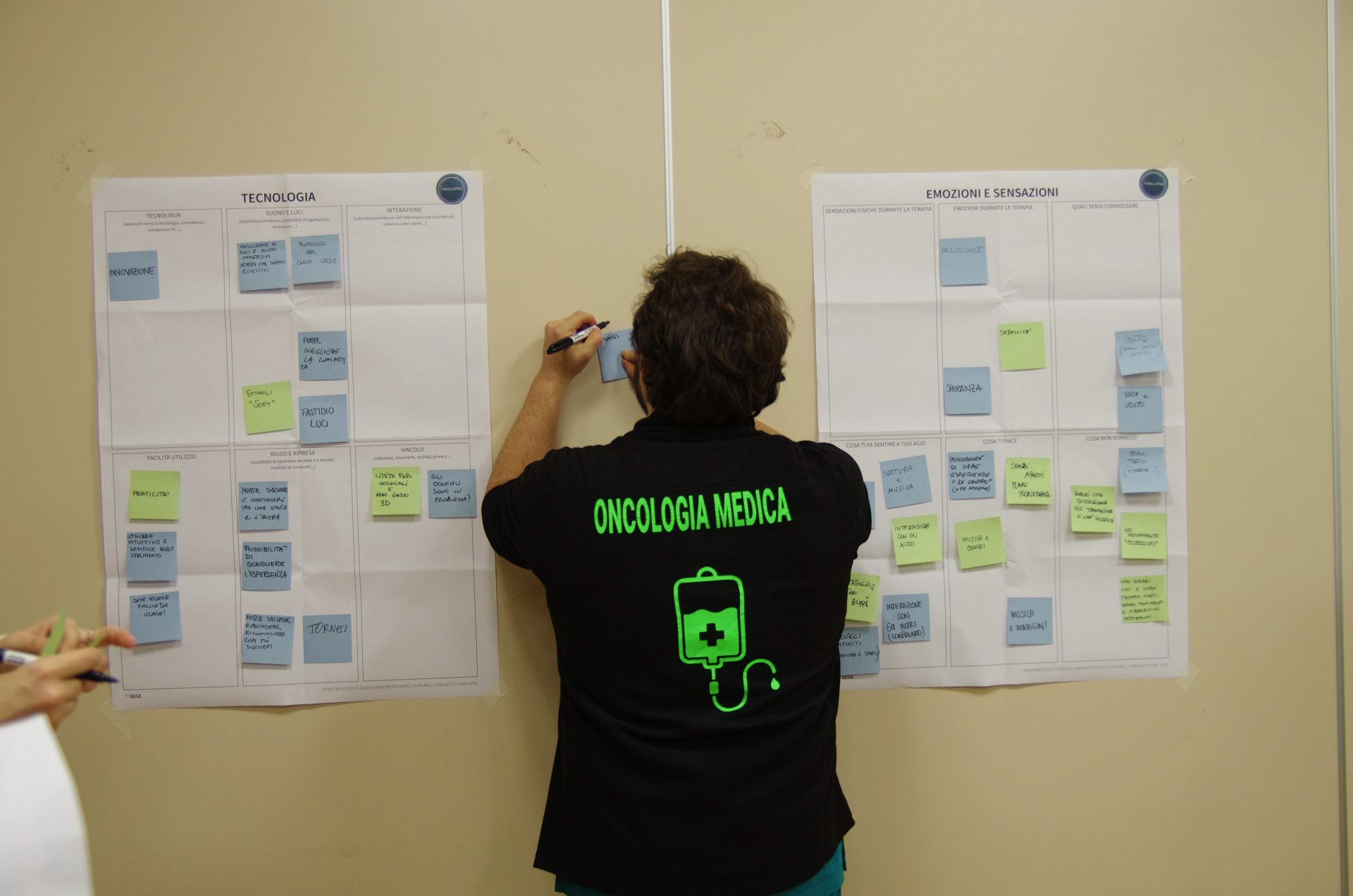
We decided to adopt a participatory approach based on the high specificity of our target users –i.e., the cancer patients –and on the acknowledgment of our difficulty to fully understand and anticipate their necessities without experiencing chemotherapy treatment in first-person.
Title
Ilaria Terrenghi, Federica Cavaletti: “The perception of time in digital environments: a patient-centred approach to using Virtual Reality to enhance well-being during chemotherapy” (2025)
Abstract
This study explores the potential of immersive virtual reality (VR) to modulate the subjective perception of time in breast cancer patients undergoing chemotherapy. As part of the ERC Proof of Concept TIMELAPSE project, the research integrates theories on temporal perception with a participatory design approach. The aim is to develop and test a VR application that improves well-being during cancer treatment. Patients, carers and healthcare professionals participated in co-design workshops and qualitative interviews, offering valuable insights to help define an immersive experience that would meet their needs and requirements. Data analysis revealed that personal factors (physical and emotional) significantly influence the degree of engagement in immersive environments. Participants clearly preferred natural scenarios, moderate levels of interactivity and simple interfaces, in line with the limitations imposed by chemotherapy sessions. These findings have informed the development of design guidelines for a VR prototype which is currently undergoing clinical validation. The study suggests that patient-centred, participatory approaches can facilitate the integration of VR into clinical practice by promoting the development of tolerable, effective and meaningful immersive tools for the psychological and sensory support of cancer patients.
Keywords
Immersive Virtual Reality, Time Passage, Cancer Patients, Participatory Design, Interaction in Digital Environments
How to cite the article
Terrenghi, I., & Cavaletti, F. (2025). The perception of time in digital environments: a patient-centred approach to using Virtual Reality to enhance well-being during chemotherapy. Journal of Inclusive Methodology and Technology in Learning and Teaching, 5(4).